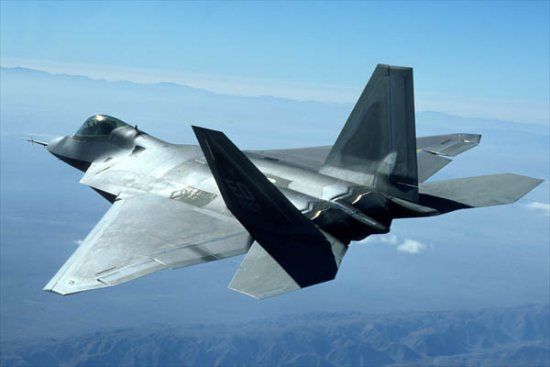
SAVE The F-22: Major 2010 Defense budget cuts announce
Before the news article, here is some great information on the F-22 and a very cool video.
Rees
Uber Stealth: Top Fighters Across the Globe
F-22 Raptor - United States
Air Superiority is the name of the game when it comes to laying the groundwork for invasion or defense. More than any other fighter in the world, the F-22 Raptor exemplifies air superiority.
Perhaps the best example of how confident the United States Air Force is in their F-22 lies within their own website.
They state that the F-22 “is designed to project air dominance, rapidly and at great distances and defeat threats attempting to deny access to our nation’s Air Force, Army, Navy and Marine Corps.”
“The F-22A cannot be matched by any known or projected fighter aircraft.”
Pretty bold statements. Judging by this website and the video below, they may just be more fact than opinion:
FACTBOX-Major weapon changes in 2010 U.S. defense budget
from Reuters
Thu May 7, 2009 2:56pm EDT
WASHINGTON, May 7 (Reuters) - The Pentagon on Thursday sent Congress a fiscal 2010 budget plan that shifts funding to focus more on irregular warfare and take better care of troops, while cutting back or canceling several major weapons programs.
Some of the recommendations, which must still be approved by Congress, call for:
- Zero funding for an alternate engine being developed by General Electric Co (GE.N) and Rolls-Royce Group Plc (RR.L) for the F-35 fighter jet, a project initiated by Congress in 1996. The program has already received $2.5 billion in funding from Congress despite repeated Pentagon attempts at cancellation.
- Termination of the VH-71 presidential helicopter program being developed by Lockheed Martin Corp (LMT.N) and its partner AgustaWestland, a unit of Italy's Finmeccanica SpA (SIFI.MI), a program that had threatened to double in cost to over $13 billion.
- Cancellation of a $15 billion Air Force competition for new Air Force combat search and rescue helicopters while military requirements are studied. Lockheed, Boeing Co (BA.N), and Sikorsky Aircraft, part of United Technologies Corp (UTX.N), have been competing for the work for several years.
Instead, the Air Force proposed spending $90 million for 2 HH-60M Pave Hawk helicopters built by Sikorsky to replenish its current search and rescue helicopter fleet.
- Cancellation of $87 billion in funding for the ground vehicle portion of the Army's Future Combat Systems (FCS) modernization program, a program run by Boeing and Science Applications International Corp (SAI.N). Army officials also said they would present a proposal for replacement vehicles by early September and seek to renegotiate the terms of the overall FCS contract in the near term.
- Cuts of $1.2 billion in funding from the missile defense program, with the lion's share of the cuts coming from the Ground-based Midcourse Defense (GMD) system built by Boeing, and the Patriot PAC-3 missile program run by Raytheon Co (RTN.N) and Lockheed. Officials said they also canceled funding for the Kinetic Energy Interceptor being developed by Northrop Grumman Corp (NOC.N).
- No funding for additional F-22 fighter jets built by Lockheed and Boeing, with the Air Force earmarking $64 million to begin closing the F-22 production line.
- Termination of the DDG-1000 destroyer after three ships instead of the seven planned, with General Dynamics Corp (GD.N) to build all three of the destroyers at its shipyard in Bath, Maine. Instead, the Navy plans to build six more DDG-51 Aegis destroyers, with that work slated to start at Northrop's Gulf coast shipyard.
- The budget also includes $431 million in "seed money" to begin a revamped aerial refueling aircraft competition between Boeing and Northrop. Officials said they expected to award a new contract in the spring of 2010.
- The budget did not include any funding for development work on a new long-range bomber, but added $500 million for upgrades to existing bombers and some $700 million for development of new radars for the B-1, B-2 and B-52 bombers.
- The budget had no funding for new Boeing C-17 transport planes, but added $91 million to begin the shutdown of the Boeing production line. That money could be cut by Congress if a measure contained in a House appropriations measure, which adds eight C-17s to the 2009 war spending bill, is approved. (Reporting by Andrea Shalal-Esa; Editing by Tim Dobbyn)
Click to read the rest of the article and the comments
Showing posts with label B-52. Show all posts
Showing posts with label B-52. Show all posts
Thursday, May 7, 2009


Monday, April 20, 2009
Thule: Welcome To The Top Of The World
 This is another really interesting article from Closing Velocity. It's also very coincidental because I just watched Dr. Strangelove on my computer about 2 weeks ago.
I was familiar with the term broken arrow, but was unaware there was still 1 bomb still unaccounted for. That by itself can make you go hmmmm... .
Closing Velocity has some great videos and the articles he writes will keep you up to date on many of our current and future defense systems.
Rees
from Closing Velocity
by John McKittrick
April 20, 2009
Great article in the Daily Mail on one of the unsung sentinels of US missile defense, the early warning radar at Thule Air Base, Greenland:
As we drive on, a disturbing buzzing and popping starts to come from the engine. The controls on the dashboard join in and the vehicle begins to judder. Our journey into this empty wasteland is starting to feel like an episode of The X Files.
'It's the radar,' she explains, pointing ahead of us, not very reassuringly. 'It does strange things to the electrics.'
I politely ask what the radar is likely to do to my insides.
'Best not to jump in front of it,' she warns.
When we reach the summit, there it is, standing guard - one of the most important and advanced pieces of American military hardware in the world, a Ballistic Missile Early Warning System (BMEWS) radar. The size of a ten-storey building and glaringly hi-tech, the radar stands perched like a silent sentinel scanning the skies for anything coming over the top of the world.
Until its recent prominence as a critical part of our budding global missile defense system, Thule was best known as the site of one of the few "Broken Arrow" crises during the Cold War.
During the sixties, the US had an operational plan "Chrome Dome" whereby a dozen nuclear-armed B-52s were always on airborne alert to counter any Soviet first strike. Though unnamed, Chrome Dome is the central plot device in Kubrick's Dr. Strangelove:
One of the underlying missions of Chrome Dome was "Hard Head" patrols over Thule, where one of these special B-52s would maintain visual contact with the airbase and its crucial radar. If the crew lost contact or saw a mushroom cloud over Thule, then they would proceed to attack the USSR with their nuclear package.
On January 21, 1968, one of these B-52s crashed on the frozen sea ice off Thule, scattering its four H-bombs. And one hydrogen bomb remains unaccounted for.
After the Thule accident, Chrome Dome was terminated.
So Thule has evolved from its Cold War roots. Once a guardian against --- and sacrificial tripwire for --- Mutually Assured Destruction, it is now on watch for limited ICBM threats from rogue nations.
And to all the chilly Thule airmen and contractors (coincidentally I recently received an email from a Closing Velocity fan up there), a hearty thanks and keep up the good work.
Stay warm...yet frosty.
Here is a glimpse of the Daily Mail article. It goes into great detail about Thule.
By GORDON CORERA
The spies at the top of the world...and a new Cold War?
This radar station is so remote that it sees no sunlight for four months of the year. It is also so powerful it could spot a tennis ball in flight 3,000 miles away. Gordon Corera visits America's controversial missile defence system in northern Greenland, where the Cold War never ended.
Click to read the rest of the article and comments
Subscribe to:
Posts (Atom)



 Posts
Posts