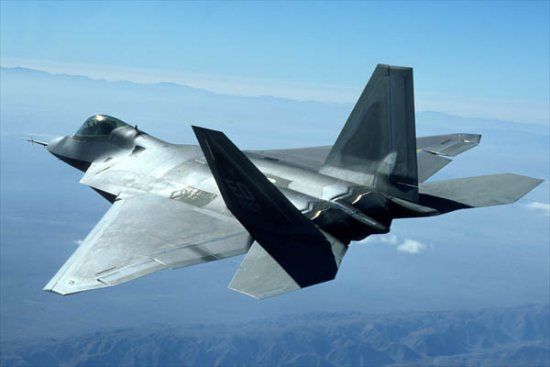
Showing posts with label F-22 Raptor. Show all posts

Friday, May 8, 2009

White House Photo Op by F-22 Raptor

Just a harmless photoshop op.

Hey Barry, the reason no alarms went off to warn you that an aircraft had penetrated the restricted airspace over the White House was because the F-22 is "STEALTH."

It works quite well, doesn't it.
Rees

Thursday, May 7, 2009

Official 2010 U.S. defense budget cuts announced

SAVE The F-22: Major 2010 Defense budget cuts announce

Before the news article, here is some great information on the F-22 and a very cool video.
Rees


Uber Stealth: Top Fighters Across the Globe

F-22 Raptor - United States

Air Superiority is the name of the game when it comes to laying the groundwork for invasion or defense. More than any other fighter in the world, the F-22 Raptor exemplifies air superiority.
Perhaps the best example of how confident the United States Air Force is in their F-22 lies within their own website.

They state that the F-22 “is designed to project air dominance, rapidly and at great distances and defeat threats attempting to deny access to our nation’s Air Force, Army, Navy and Marine Corps.”

“The F-22A cannot be matched by any known or projected fighter aircraft.”

Pretty bold statements. Judging by this website and the video below, they may just be more fact than opinion:

FACTBOX-Major weapon changes in 2010 U.S. defense budget
from Reuters
Thu May 7, 2009 2:56pm EDT

WASHINGTON, May 7 (Reuters) - The Pentagon on Thursday sent Congress a fiscal 2010 budget plan that shifts funding to focus more on irregular warfare and take better care of troops, while cutting back or canceling several major weapons programs.

Some of the recommendations, which must still be approved by Congress, call for:

- Zero funding for an alternate engine being developed by General Electric Co (GE.N) and Rolls-Royce Group Plc (RR.L) for the F-35 fighter jet, a project initiated by Congress in 1996. The program has already received $2.5 billion in funding from Congress despite repeated Pentagon attempts at cancellation.

- Termination of the VH-71 presidential helicopter program being developed by Lockheed Martin Corp (LMT.N) and its partner AgustaWestland, a unit of Italy's Finmeccanica SpA (SIFI.MI), a program that had threatened to double in cost to over $13 billion.

- Cancellation of a $15 billion Air Force competition for new Air Force combat search and rescue helicopters while military requirements are studied. Lockheed, Boeing Co (BA.N), and Sikorsky Aircraft, part of United Technologies Corp (UTX.N), have been competing for the work for several years.

Instead, the Air Force proposed spending $90 million for 2 HH-60M Pave Hawk helicopters built by Sikorsky to replenish its current search and rescue helicopter fleet.

- Cancellation of $87 billion in funding for the ground vehicle portion of the Army's Future Combat Systems (FCS) modernization program, a program run by Boeing and Science Applications International Corp (SAI.N). Army officials also said they would present a proposal for replacement vehicles by early September and seek to renegotiate the terms of the overall FCS contract in the near term.

- Cuts of $1.2 billion in funding from the missile defense program, with the lion's share of the cuts coming from the Ground-based Midcourse Defense (GMD) system built by Boeing, and the Patriot PAC-3 missile program run by Raytheon Co (RTN.N) and Lockheed. Officials said they also canceled funding for the Kinetic Energy Interceptor being developed by Northrop Grumman Corp (NOC.N).

- No funding for additional F-22 fighter jets built by Lockheed and Boeing, with the Air Force earmarking $64 million to begin closing the F-22 production line.

- Termination of the DDG-1000 destroyer after three ships instead of the seven planned, with General Dynamics Corp (GD.N) to build all three of the destroyers at its shipyard in Bath, Maine. Instead, the Navy plans to build six more DDG-51 Aegis destroyers, with that work slated to start at Northrop's Gulf coast shipyard.

- The budget also includes $431 million in "seed money" to begin a revamped aerial refueling aircraft competition between Boeing and Northrop. Officials said they expected to award a new contract in the spring of 2010.

- The budget did not include any funding for development work on a new long-range bomber, but added $500 million for upgrades to existing bombers and some $700 million for development of new radars for the B-1, B-2 and B-52 bombers.

- The budget had no funding for new Boeing C-17 transport planes, but added $91 million to begin the shutdown of the Boeing production line. That money could be cut by Congress if a measure contained in a House appropriations measure, which adds eight C-17s to the 2009 war spending bill, is approved. (Reporting by Andrea Shalal-Esa; Editing by Tim Dobbyn)
Click to read the rest of the article and the comments

Monday, April 13, 2009

Why isn’t the F-22 Raptor part of a stimulus?

from Hot Air.com
April 13, 2009
by Ed Morrissey

The Obama administration has put together both a $700 billion stimulus package and a $3.5 trillion budget for the coming year, claiming that government spending will restart the flopping economy. Obama wanted to focus on “shovel-ready” projects to get ditch-digging started as soon as possible. However, the Pentagon tubed a program that not only had people already employed but also produced the kind of fighters that keeps America dominant in the skies. Hugh Hewitt wonders in today’s Washington Examiner why this shovel-ready project got buried:

The planes cost less than $150 million each to build. We can get 100 more F-22s for $15 billion. Given that our six-month deficit for the fiscal year under way is already scraping $1 trillion, what’s $15 billion for an extended run of unchallenged air superiority against existing and –crucially—unknown threats?

Did I mention that the F-22 is shovel ready? Remember all those jobs President Obama wanted to “create or save”? Evidently there is a category of jobs he doesn’t count among those worthy of retention –those on the national security shift.

Even if the Raptor wasn’t a guarantor of margins of safety for every American soldier, sailor or Marine operating below its shield, even then you’d have to conclude that the shuttering of its production line in an era of giant job losses was indicative of a remarkable, deeply ideological hostility towards defense spending.

The second coming of the Carter Administration is upon us, heralded by this almost wanton sluffing away of a weapon of unmatched capabilities and the simultaneous paring of missile defense appropriations.

The Carter reference, in this case, relates to Jimmy Carter’s cancellation of the B-1 bomber program shortly after taking office. I recall this quite clearly, as the Admiral Emeritus worked for Rockwell International, the prime contractor for the B-1, and would have lost his job had he transferred to that program as he had been planning. Carter decided to cancel the B-1 to focus on the new work being done in stealth technology, but Ronald Reagan reinstated it, convinced that America could walk and chew gum at the same time.

This seems like a similar circumstance. The question for the Pentagon appears to have been whether to buy more Raptors or wait for the F-35 Lightning II deliveries in a couple of years. The correct answer would have been to do both; buy more Raptors and keep 95,000 people employed, while waiting for the Lightning IIs.

Would it cost more money? Of course, but let’s put that in perspective. Fifteen billion dollars amounts to a whopping 2% of the total price tag for Porkulus. Unlike at least half of Porkulus’ spending, it would actually provide immediate work, saving existing American jobs. Not just any jobs, mind you, but hard-core, high-paying manufacturing jobs, the kind that politicians like Barack Obama laments when they disappear. I’d guess that many of them are union jobs, too.

Unlike most of the supposedly shovel-ready projects in Porkulus, this delivers a usable, valuable product that serves the government’s legitimate purpose of national defense. It doesn’t feed the pork-barrel demands of Congress, and most importantly, it’s a proven military system.

I wrote in February that the Raptor was a no-brainer for a government looking to provide economic stimulus. I got the “no brain” part right.
Click to read the article and comments

Wednesday, April 8, 2009

Obama and Gates Gut the Military - ACORN Yes! - F-22's No!

ACORN is an unconstitutional, federally funded arm of the Democratic Party. ACORN enables fraudulent registration and they directly campaign for the Democratic party.

Obama wants to stop building F-22's and also cut critical Missile Defense Systems. And to think they propose these type of cuts right after North Korea launched their ICBM that has a potential range of Hawaii and Alaska. Great decision Obama! Increase the budget for ACORN and decrease critical defense programs.
Rees


The secretary's new budget will leave us weaker to pay for the president's domestic programs.

from The Wall Street Journal
By THOMAS DONNELLY and GARY SCHMITT
April 8, 2009

On Monday, Defense Secretary Robert Gates announced a significant reordering of U.S. defense programs. His recommendations should not go unchallenged.

In the 1990s, defense cuts helped pay for increased domestic spending, and that is true today. Though Mr. Gates said that his decisions were "almost exclusively influenced by factors other than simply finding a way to balance the books," the broad list of program reductions and terminations suggest otherwise. In fact, he tacitly acknowledged as much by saying the budget plan represented "one of those rare chances to match virtue to necessity" -- the "necessity" of course being the administration's decision to reorder the government's spending priorities.

However, warfare is not a human activity that directly awards virtue. Nor is it a perfectly calculable endeavor that permits a delicate "balancing" of risk. More often it rewards those who arrive on the battlefield "the fustest with the mostest," as Civil War Gen. Nathan Bedford Forrest once put it. If Mr. Gates has his way, U.S. forces will find it increasingly hard to meet the Forrest standard. Consider a few of the details of the Gates proposals:

- The termination of the F-22 Raptor program at just 187 aircraft inevitably will call U.S. air supremacy -- the salient feature, since World War II, of the American way of war -- into question. [Hey Obama - this decision will eliminate 98,00 jobs - my comment]

The need for these sophisticated, stealthy, radar-evading planes is already apparent. During Russia's invasion of Georgia, U.S. commanders wanted to fly unmanned surveillance aircraft over the region, and requested that F-22s sanitize the skies so that the slow-moving drones would be protected from Russian fighters or air defenses. When the F-22s were not made available, likely for fear of provoking Moscow, the reconnaissance flights were cancelled.

As the air-defense and air-combat capabilities of other nations, most notably China, increase, the demand for F-22s would likewise rise. And the Air Force will have to manage this small fleet of Raptors over 30 years. Compare that number with the 660 F-15s flying today, but which are literally falling apart at the seams from age and use. The F-22 is not merely a replacement for the F-15; it also performs the functions of electronic warfare and other support aircraft. Meanwhile, Mr. Gates is further postponing the already decades-long search for a replacement for the existing handful of B-2 bombers.

- The U.S. Navy will continue to shrink below the fleet size of 313 ships it set only a few years ago. Although Mr. Gates has rightly decided to end the massive and expensive DDG-1000 Zumwalt destroyer program, there will be additional reductions to the surface fleet. The number of aircraft carriers will drop eventually to 10. The next generation of cruisers will be delayed, and support-ship projects stretched out. Older Arleigh Burke destroyers will be upgraded and modernized, but at less-than-needed rates.

The good news is that Mr. Gates will not to reduce the purchases of the Littoral Combat Ship, which can be configured for missions from antipiracy to antisubmarine warfare. But neither will he buy more than the 55 planned for by the previous Bush administration. And the size and structure of the submarine fleet was studiously not mentioned. The Navy's plan to begin at last to procure two attack submarines per year -- absolutely vital considering the pace at which China is deploying new, quieter subs -- is uncertain, at best.

- Mr. Gates has promised to "restructure" the Army's Future Combat Systems (FCS) program, arguing that the lessons of Iraq and Afghanistan have called into question the need for new ground combat vehicles. The secretary noted that the Army's modernization plan does not take into account the $25 billion investment in the giant Mine Resistant Ambush-Protected (MRAP) vehicles. But it's hard to think of a more specialized and less versatile vehicle.

The MRAP was ideal for dealing with the proliferation of IEDs (improvised explosive devices) in Iraq. But the FCS vehicle -- with a lightweight yet better-protected chassis, greater fuel efficiency and superior off-road capacity -- is far more flexible and useful for irregular warfare. Further, the ability to form battlefield "networks" will make FCS units more effective than the sum of their individual parts. Delaying modernization means that future generations of soldiers will conduct mounted operations in the M1 tanks and Bradley fighting vehicles designed in the 1970s. Finally, Mr. Gates capped the size of the U.S. ground force, ignoring all evidence that it is too small to handle current and future major contingencies.

- The proposed cuts in space and missile defense programs reflect a retreat in emerging environments that are increasingly critical in modern warfare. The termination of the Airborne Laser and Transformational Satellite programs is especially discouraging.

The Airborne Laser is the most promising form of defense against ballistic missiles in the "boost phase," the moments immediately after launch when the missiles are most vulnerable. This project was also the military's first operational foray into directed energy, which will be as revolutionary in the future as "stealth" technology has been in recent decades. The Transformational Satellite program employs laser technology for communications purposes, providing not only enhanced bandwidth -- essential to fulfill the value of all kinds of information networks -- but increased security.

Mr. Gates justifies these cuts as a matter of "hard choices" and "budget discipline," saying that "[E]very defense dollar spent to over-insure against a remote or diminishing risk . . . is a dollar not available to take care of our people, reset the force, win the wars we are in." But this calculus is true only because the Obama administration has chosen to cut defense, while increasing domestic entitlements and debt so dramatically.

The budget cuts Mr. Gates is recommending are not a temporary measure to get us over a fiscal bump in the road. Rather, they are the opening bid in what, if the Obama administration has its way, will be a future U.S. military that is smaller and packs less wallop. But what is true for the wars we're in -- that numbers matter -- is also true for the wars that we aren't yet in, or that we simply wish to deter.

Mr. Donnelly is a resident fellow and Mr. Schmitt is a resident scholar at the American Enterprise Institute. They are co-editors of "Of Men and Materiel: the Crisis in Military Resources" (AEI, 2007).
Click to read the article and comments